


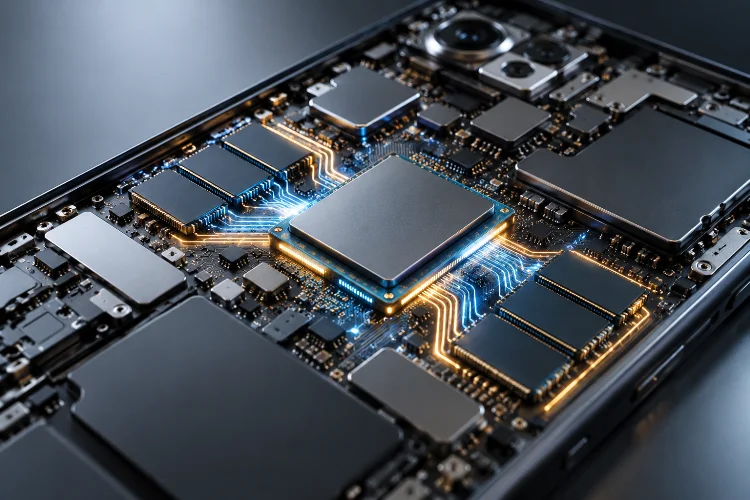
Modern smartphone processors are becoming ridiculously fast.
Flagship chips now combine powerful CPU cores, desktop-inspired GPUs, dedicated neural processors, advanced camera engines, and increasingly sophisticated AI accelerators inside a package small enough to fit in your pocket.
But making those processing units faster creates another problem: they need to receive data quickly enough to stay busy.
That is where memory bandwidth in modern mobile processors becomes increasingly important. A processor may have impressive clock speeds or huge theoretical computing power, but those numbers mean little if the memory subsystem cannot supply data at a similar pace.
The issue becomes even more noticeable with mobile gaming, computational photography, high-resolution displays, generative AI, and multitasking. All these workloads can move enormous amounts of data between RAM and different sections of the system-on-chip.
As a result, smartphone performance is no longer simply about having the fastest CPU. Memory speed, cache design, bandwidth, latency, and power efficiency are becoming equally important parts of the equation.
What Exactly Is Memory Bandwidth?
Memory bandwidth describes how much data can theoretically move between system memory and the processor during a given amount of time.
Think of it as a highway.
Processor cores are like factories waiting for raw materials. Memory provides those materials, while the memory bus acts as the road connecting them.
Making the CPU faster is like building a larger factory. If the road supplying it remains narrow, trucks begin forming a traffic jam and the factory cannot operate at full capacity.
Bandwidth is normally influenced by several factors, including memory transfer rate, bus width, and the number of memory channels available.
Mobile processors commonly use LPDDR memory because it is designed to balance high performance with low energy consumption. Current flagship platforms increasingly rely on LPDDR5X, while transfer rates have continued climbing considerably.
For example, MediaTek lists LPDDR5X at up to 10,667 Mbps on its Dimensity 9400 platform.
That kind of speed is becoming necessary because modern SoCs have far more components competing for memory access than older smartphone processors.
Modern Mobile Chips Have More Data-Hungry Components
Early smartphone chips had relatively modest computing requirements. A CPU handled most general workloads, while simpler GPUs took care of basic graphics.
Today’s mobile SoCs are completely different.
One processor can contain several CPU clusters, a large GPU, neural processing units, image signal processors, video encoders, security hardware, display engines, and other accelerators.
Many of these components access the same pool of system memory.
Arm points out an important difference between desktop PCs and mobile hardware. Desktop systems often have separate system RAM and dedicated graphics memory, while mobile devices typically share LPDDR memory accross the CPU, GPU, and other parts of the SoC.
That shared architecture saves space and power, but it also creates competition for available bandwidth.
If several processing engines are active simultaneously, memory traffic can become a bottleneck even when individual CPU or GPU cores have plenty of theoretical computing performance left.
Mobile Gaming Is Increasingly Bandwidth Hungry
Gaming provides one of the clearest examples.
A modern mobile game constantly moves textures, geometry, animation data, lighting information, frame buffers, and other assets through the memory system.
Higher display resolutions increase that pressure.
Rendering a game at 1440p requires processing substantially more pixels than rendering the same scene at 1080p. Add high refresh rates such as 120Hz or 144Hz, advanced shaders, ray tracing, and high-resolution texture packs, and memory demands climb quickly.
This means simply increasing GPU clock speed does not guarantee proportional performance gains.
At some point, the GPU may spend more time waiting for data.
A wider or faster memory subsystem helps prevent that problem by feeding graphics cores more efficiently. It is one reason premium mobile platforms increasingly pair stronger GPUs with faster LPDDR generations.
Samsung has demonstrated LPDDR5X memory operating at 8.5 Gbps on Snapdragon mobile platforms, highlighting the industry’s effort to increase mobile memory throughput.
Better bandwidth can translate into more stable frame rates, faster asset loading, and fewer situations where an otherwise powerful GPU becomes starved for data.
AI Makes Memory Performance Even More Important
Artificial intelligence is another major reason mobile memory bandwidth matters more today.
Modern smartphones increasingly run AI models locally rather than sending everything to cloud servers. Examples include photo enhancement, voice processing, image generation, live translation, object detection, and generative AI assistants.
Neural processors can perform trillions of operations per second, but those operations depend on data.
AI models contain large collections of parameters that have to be accessed during inference. Moving those parameters between memory and the NPU can become a major performance constraint.
This is why AI performance cannot be judged only by TOPS, or trillions of operations per second.
A processor advertising an extremely powerful neural engine may still underperform in some workloads if its memory architecture cannot feed the accelerator quickly enough.
The same principle can be seen beyond smartphones. Qualcomm specifically associates the 135 GB/s LPDDR5X bandwidth of Snapdragon X platforms with faster AI workloads and multitasking.
Although smartphones operate under diffrent power and memory configurations, the architectural principle is similar: stronger compute engines require enough memory throughput to keep them productive.
Computational Photography Moves Huge Amounts of Data
Smartphone cameras also place significant pressure on the memory subsystem.
Capturing a photo today involves much more than recording a single frame from the camera sensor.
A flagship device may capture multiple exposures almost instantly, align them, remove noise, combine dynamic ranges, detect faces, segment objects, apply HDR processing, and enhance specific parts of the scene using machine learning.
Now imagine doing something similiar while recording 4K or 8K video.
MediaTek’s Dimensity 9400, for example, supports 8K video functionality alongside a powerful GPU, NPU, image processor, and LPDDR5X memory subsystem.
These workloads require large amounts of image data to move through the chip quickly.
Insufficient memory throughput could force processors to wait, increase processing time, or limit how many computational photography techniques can operate simultaneously.
Higher bandwidth therefore contributes not just to benchmark scores but to practical features such as faster image processing, responsive camera interfaces, and advanced video recording.
Cache Helps, but It Cannot Replace Fast Memory
Modern processors do not access main RAM every time they need data.
Instead, they use caches.
Caches are much smaller than system memory but significantly faster. Frequently accessed information can remain close to CPU, GPU, or NPU cores, reducing the need to repeatedly request data from external RAM.
Modern mobile processors increasingly use large shared caches partly for this reason.
For example, the Dimensity 9400 includes 12MB of L3 cache and 10MB of system-level cache alongside its LPDDR5X memory support.
Caching can reduce bandwidth pressure dramatically when workloads reuse the same data.
However, cache capacity is limited.
Large games, AI models, camera buffers, and multitasking workloads eventually exceed available cache space. Once that happens, the processor must return to external memory.
The best mobile architectures therefore combine fast caches with high-bandwidth LPDDR rather than treating one as a replacement for the other.
More Bandwidth Does Not Automatically Mean Better Performance
Memory specifications need context.
A phone with faster LPDDR memory will not automatically outperform every device using slower RAM.
Actual performance depends on the complete memory subsystem, including controller design, channel configuration, caching, latency, software scheduling, and processor architecture.
Theoretical bandwidth also differs from real-world achievable bandwidth.
Another complication is power consumption.
Moving data costs energy. Constantly transferring information between memory and processing cores can consume a meaningful portion of the system’s power budget.
That is why mobile memory standards are designed not only to become faster but also more energy effecient.
Samsung describes LPDDR5X as improving both transfer performance and power efficiency, which is particularly valuable in battery-powered devices.
The goal is therefore not simply maximum bandwidth. Smartphone designers want enough bandwidth for demanding workloads without unnecessarily increasing battery drain or heat.
Why Faster CPUs Alone Are No Longer Enough
Processor development historically focused heavily on CPU clock speeds.
That approach becomes less useful when other parts of the chip cannot keep pace.
Imagine doubling the theoretical computing capability of a GPU while leaving its memory throughput unchanged. Some workloads may become faster, but bandwidth-heavy workloads could improve far less because the GPU spends more time waiting for information.
This is known as a memory bottleneck.
Modern chip designers solve it through multiple approaches: faster LPDDR, wider memory interfaces, better compression, larger caches, smarter prefetching, and improved data locality.
Bandwidth therefore works together with architecture.
This explains why comparing smartphone processors using CPU GHz alone has become increasingly meaningless. A modern SoC is an interconnected computing system rather than simply a collection of CPU cores.
Memory Bandwidth Will Matter Even More in Future Phones
The trend is unlikely to slow down.
Mobile GPUs continue becoming more capable. Camera sensors generate larger datasets. Displays are increasing in resolution and refresh rate, while generative AI models are expanding rapidly.
All of those developments place additional pressure on memory.
MediaTek’s Dimensity 9300+ supported memory speeds up to 9,600 Mbps, while later flagship platforms such as the Dimensity 9400 reached 10,667 Mbps.
That progression illustrates how memory systems are evolving alongside CPU, GPU, and AI processing capability.
Future mobile processors will likely rely increasingly on smarter caching, memory compression, higher-bandwidth LPDDR generations, and better ways of reducing unnecessary data movement.
In many cases, reducing how much data needs to travel may be just as valuable as increasing how fast it can travel.
Memory bandwidth has become one of the most important – and often overlooked – factors behind modern smartphone performance.
As mobile processors add stronger GPUs, neural accelerators, sophisticated camera engines, and increasingly powerful CPU cores, all those components need rapid access to data.
Without enough bandwidth, expensive processing hardware can spend valuable time simply waiting for memory.
That is why specifications such as LPDDR generation, memory speed, cache capacity, and memory architecture deserve more attention when comparing new mobile processors.
The next time you evaluate a flagship smartphone, don’t look only at CPU clocks or AI TOPS. Check the memory subsystem too. It can reveal a lot about how well the processor will handle tomorrow’s games, cameras, multitasking, and on-device AI.
